Plants in Profile: Chamomile
Jun 29, 2021
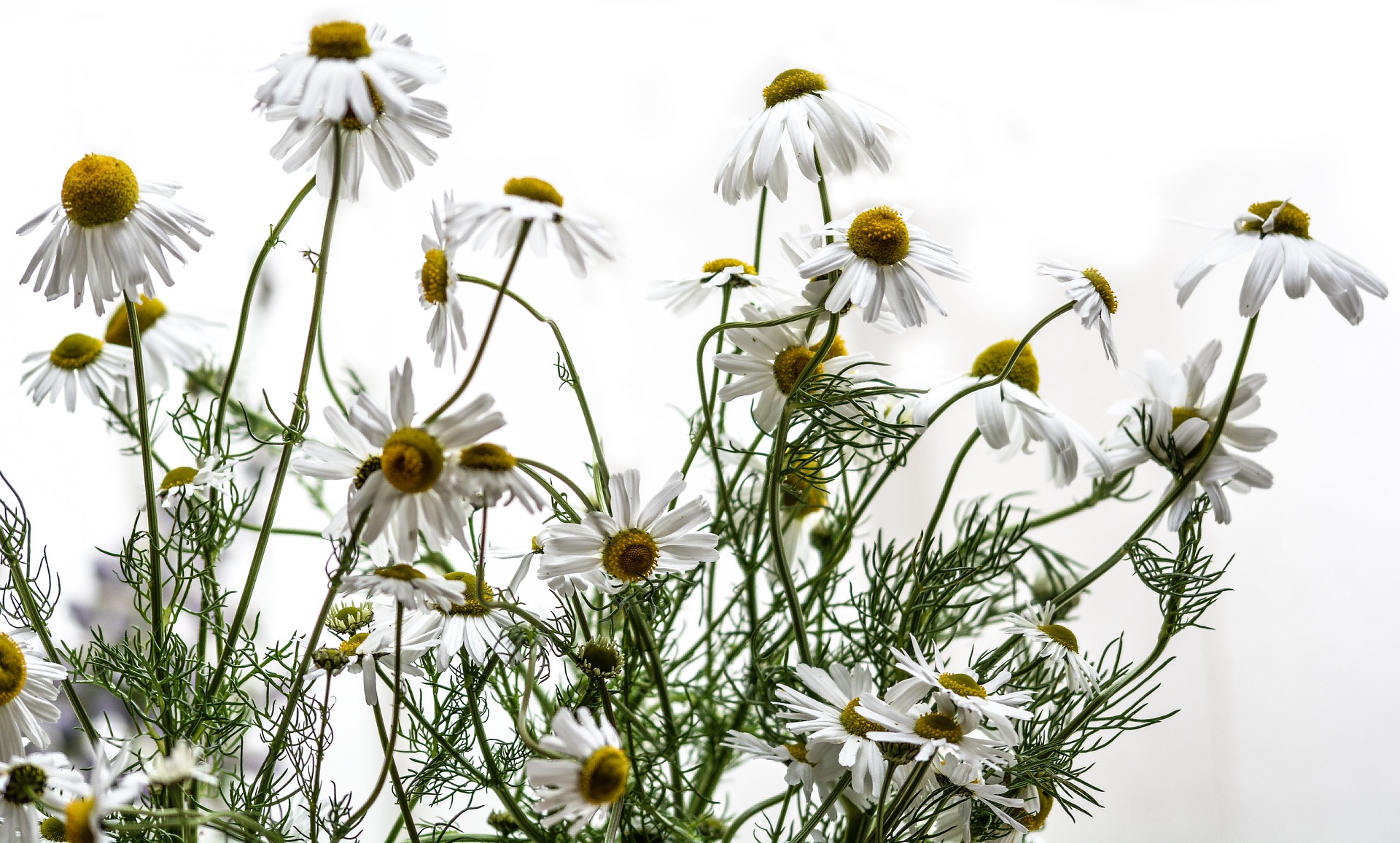
My Current Chamomile Obsession 🌼
It would be fair to say I’m on a massive chamomile buzz lately.
It’s not just because of the tea (although yes, I’m drinking a lot of it). Chamomile has a special place in my mind - and in my polytunnel - because it’s the first herb I’ve grown and successfully harvested in a decent quantity. There’s something incredibly satisfying about picking those tiny daisy-like flowers and knowing they’ll end up in your cup later that evening.
But beyond my personal attachment, chamomile is one of the most ancient and extensively studied medicinal herbs known to humankind. And once you start digging into the science and history behind it, you realise this little flower is kind of extraordinary.
Most of us - myself included - are first drawn to chamomile in pursuit of relaxation and sleep. It’s widely known for its gentle anxiolytic effects, but relaxation is only part of the story. Beneath those delicate dried flowers lies a rich mix of terpenoids and flavonoids - compounds that give chamomile a surprisingly broad range of medicinal properties. Its preparations are commonly used for many human ailments such as hay fever, inflammation, muscle spasms, menstrual disorders, skin disorders, insomnia, ulcers, wounds, gastrointestinal disorders and rheumatic pain.
There are over 50,000 publications on chamomile and numerous books touting its amazing benefits. There is still a lot of active research on the chemistry of chamomile where research and industrial groups are trying to optimise the extraction of chamomile molecules for maximum yield and stability, as well as understanding the benefits its extracts have.
A Herb with Thousands of Years of History
This is an excerpt from the book Chamomile: Industrial Profiles (2005)

Chamomile is listed in the pharmacopoeia of 26 countries. Pharmacopoeias are books containing approved quantities and dosages of medicines in each country. In 1882, Germany were the first to include chamomile flowers and their extractions in their pharmacopoeia.
To go even further back:
Chamomile has been used in herbal remedies for thousands of years, known in ancient Egypt, Greece, and Rome.
The Egyptians considered the plant sacred and believed it was a gift from the Sun God Ra.
Anglo-Saxons also attributed a religious stature to chamomile as it earned a place in their cohort of 9 sacred herbs. Their 9 holy herbs were:
- Mugwort
- Plantain
- Lamb’s cress
- Nettle
- Cockspur grass
- German chamomile
- Crab-apple
- Thyme
- Fennel
Taxonomy and Etymology

German chamomile (left), Roman chamomile (right).
-
Chamomile is a member of the daisy or Asteraceae family.
-
There are many chamomile species that grow wild, but the two we grow for benefits are:
-
German chamomile (Matricaria recutita) — also known as “True chamomile”
-
Roman chamomile (Chamaemelum nobile)
-
Taste differences:
-
Roman chamomile tends to be bitter when used in tea.
-
German chamomile is sweeter.
-
German chamomile is hardier, produces larger yields, and contains higher levels of chamazulene (important for essential oil production).
Apparently, you can expect 300 kg of flowers per acre of Bodegold German chamomile.
Chamomile is said to smell like crushed apple. The name comes from two Greek words:
-
Khamai: “on the ground”
-
Melon: “apple”
Where does it grow?
Chamomile grows wild across Europe and is highly cultivated in Eastern Europe.
It is also grown in:
- Germany
- Hungary
- France
- Russia
- Yugoslavia
- Brazil
- India
It was introduced to India around 300 years ago during the Mughal period and is now cultivated widely.
It can also be found in:
- North Africa
- Asia
- North & South America
- Australia
- New Zealand
Production
Hungary is the main producer of chamomile.
It grows abundantly in poor soils and provides income to poorer communities. Flowers are exported to Germany for oil distillation.
Global Consumption
-
Over 1 million cups of chamomile tea are reportedly drunk every day.
-
Germany consumed about 5000 tonnes in 1992.
-
Australia demand: >50 tonnes.
-
Italy demand: 1000–1200 tonnes annually (~€3 million).
Modern Findings on Chamomile
-
Cultivation and breeding began ~100 years ago.
-
1921: Chemiewerke Homburg patented the first chamomile extract.
-
Over the past 40 years, chamomile has become a major cultivated crop.
-
Pharmacopoeia Requirements (German Chamomile)
-
Blue essential oil: minimum 4 ml/kg (dried drug)
-
Total apigenin-7-glucoside: minimum 0.25%
Antimicrobial Effects of German Chamomile
-
Essential oil is bactericidal against Gram-positive bacteria.
-
Fungicidal against Candida albicans at 0.7% V/V.
-
Not effective against Gram-negative bacteria (even at 8%).
-
In a study of 20 volunteers with induced dermatitis, chamomile ointment was significantly more effective than 0.1% hydrocortisone acetate (p < 0.01).
Legal Classification (Germany & EU)
Chamomile flowers can be distributed both as:
- A foodstuff
- A drug
As a medicinal product, it must meet pharmacopoeia standards, including minimum essential oil content.
Chamomile is now used across many industries in multiple forms.

Pharmacological profile

Key active compounds:
- Apigenin
- α-Bisabolol
- Chamazulene
Apigenin
- Apigenin is a flavonoid and one of the most studied nutraceuticals.
- Chamomile contains ~840 mg per 100 g — making it one of the richest dietary sources.
Anxiolytic Effects
- Apigenin reduces anxiety.
- Acts on GABA-A receptors (same targets as benzodiazepines).
- Crosses the blood-brain barrier.
- May inhibit monoamine oxidase → increasing serotonin availability.
- Can have sedative effects at higher doses.
Anti-Cancer Effects
- Selectively inhibits cancer cell growth.
- 20 μM apigenin inhibited proliferation in cultured breast cancer cells.
- Also anti-inflammatory, neuroprotective, anti-diabetic.
- High safety threshold.

Other sources of apigenin:
- Parsley, celery, onions
- Oranges
- Thyme, oregano, basil
- Tea, beer, wine
(–)-α-Bisabolol
Isolated in 1951.
- Anti-irritant
- Anti-inflammatory
- Antimicrobial
- Enhances skin absorption
Effective against:
- Staphylococcus aureus
- Streptococcus
- Candida albicans
Widely used in cosmetics, mouthwashes, and toothpaste.
Chamazulene
The compound responsible for chamomile’s famous blue oil.
- Formed during steam distillation.
- Potent antioxidant and anti-inflammatory.
- Effective for eczema and psoriasis.
Isolated in 1863; structure resolved in 1953.
Part of the Plant Used
The flower heads contain the highest concentration of beneficial compounds and essential oils.
Oil is distilled from fresh and dried flowers - fresher flowers give higher yields.
Conclusion
Chamomile grows easily and is absolutely teeming with benefits.
Get some chamomile tea. Drink it. 🌼