Rainmaking Bacteria
Nov 4, 2021
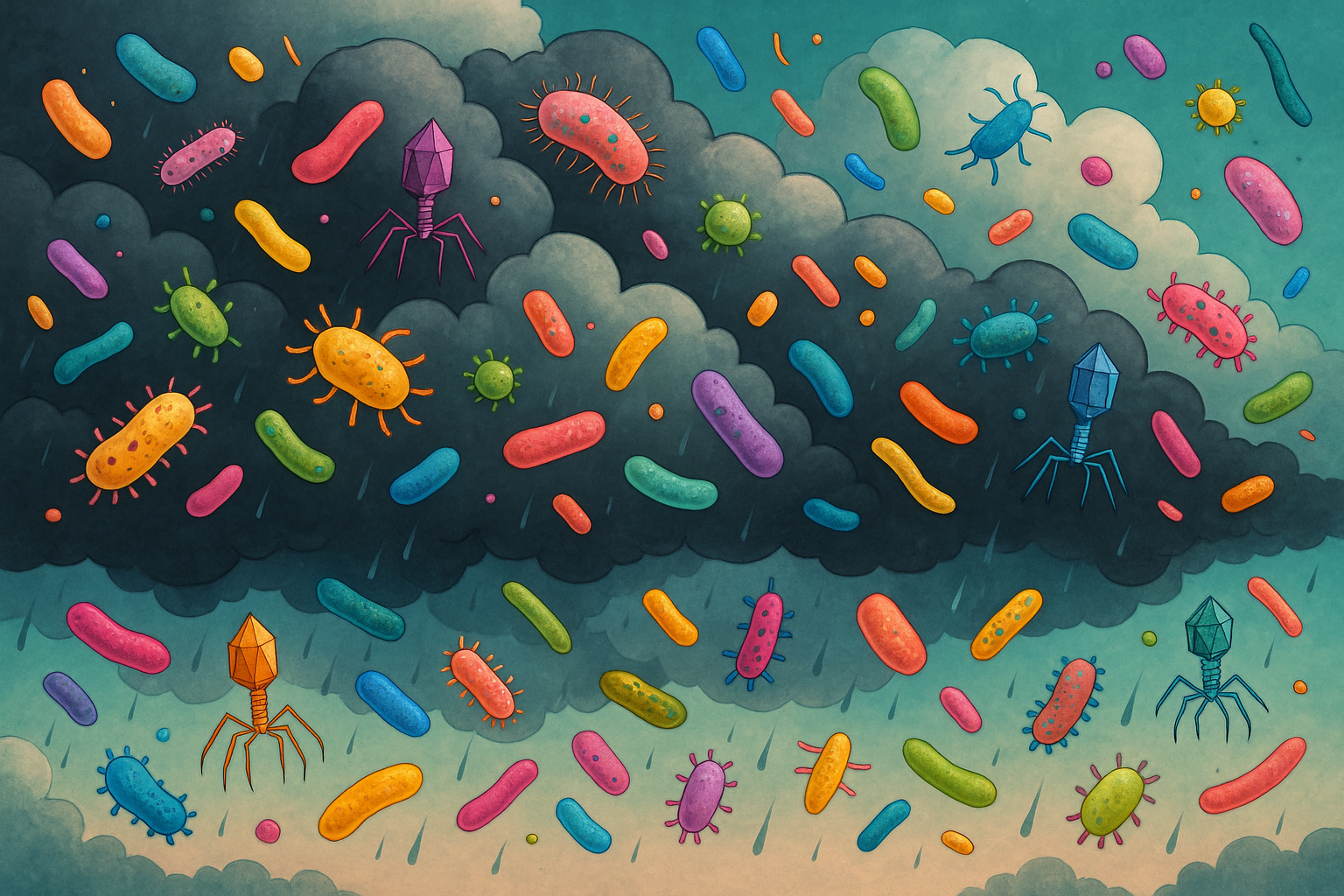
Thank you Keith Bell, the microbiome mind behind the Gut Club, for sending me your wonderful little book. Keith weaves the story of bacteria’s role in the weather cycle and the environment with the rainmaking ritual of Native Americans.
After coming away from the book skeptical that bacteria can cause rain, I was shocked after a quick bit of research to learn that microbes have been found to form the nuclei around which ice condenses - therefore creating rain. This theory, called bioprecipitation, was first proposed by David Sands from Montana State University in 1982.
Bacteria get swept into the atmosphere by wind, travel huge distances in clouds, and then fall back to Earth in a heavy shower where they colonize plant surfaces to renew the cycle.
Now I get that the microbiome is a global system that we are inhabiting, rather than them inhabiting a portion of us. Even though I had read about the Gaia hypothesis, I wasn’t nearly open-minded enough when initially reading this book. Now I’m amazed at the growing research in aerobiology and plant-colonizing bacteria originating from inner outer space (Keith’s words, not mine).
I wonder what it’s like to be a raindrop?
The story unfolds with Chloe and Eli (the illustrator Brent Bludsworth’s children) playing inside by the window while it is raining heavily outside.
Three raindrops appear - Drippy, Droppy and Droopey - who offer the children their wisdom on what it’s like to be a raindrop. In a bizarre turn of events, three ice cubes appear. They are the raindrops’ teachers and are actually bacteria frozen inside ice.

Icy, Freezy and Frozey (the bacteria) describe how they wait for wind to blow them into the sky where they can form ice clouds and then fall back to Earth as rain to start the process again.

It’s vibrant and charming.

Keith poses the hard-hitting question: what will happen if we continue to spray our crops with pesticides that kill bacteria - when we need them to produce rain?
This is a connection I hadn’t considered before, and one more jigsaw piece in the picture of how humans are disrupting the natural flow of our environment.
I also enjoyed the nod to Native American rainmaking rituals and the thought experiment that dancing around and kicking up enough dust could cause rain.
Without giving away the entire story, I’ll just say that this is a cute book with an important message to inspire children and adults alike.
Bacteria’s role in ice nucleation
So are bacteria really involved in ice formation and rain? I had to investigate.
This article points to Brent Christensen’s team’s work. A microbiologist we are previously previously familiar with for profiling ancient bacteria locked in glaciers in Lake Vostok in Antarctica.
His team tested the freezing point of snow samples taken from Europe, North America and Antarctica.
At temperatures warmer than −40ºC, ice formation does not happen easily or spontaneously. Ice formation requires a central particle that forms the “nucleus” of condensation. These particles can be minerals - or biological entities such as bacteria.
They found that snow samples containing microorganisms were able to form ice at temperatures close to 0ºC - much higher than samples containing only minerals.
Source: Ubiquity of biological ice nucleators in snowfall
Most interestingly, samples were collected during seasons and in locations where no deciduous plants existed. The authors concluded that bacteria must have been transported long distances via the precipitation cycle while maintaining their ice-nucleating ability in the atmosphere.
Bioprecipitation
In the same way fungal spores and seeds can be dispersed by wind, bacteria can travel too.
- The phyllosphere (surface area of plants) is home to many bacteria and microbes.
- Microbes living on plants can become airborne aerosols.
- The atmosphere serves as a vehicle for microbial dispersal locally and globally.
- Airborne microbes are deposited back to Earth’s surface through rain.
- Proteobacteria, followed by Bacteroidetes, Actinobacteria and Firmicutes, are common in the atmosphere, precipitation and phyllosphere.
Rain as bacterial reservoirs
 The phyllosphere is the total surface area of a plant where microbes can inhabit.
A paper published this year titled Experimental evidence pointing to rain as a reservoir of tomato phyllosphere microbiota found that tomato plants exposed to rain had a larger microbial population on their leaves than plants not exposed to rain.
Using 16S rRNA sequencing, they found enrichment of bacterial populations on outdoor-grown plants.
To test this further, they sterilized soil by autoclaving and separated plants into three groups:
-
Concentrated rain microbiota
-
Filter-sterilized rain
-
Sterile water
Leaves were collected seven days later for sequencing.
104 OTUs were significantly increased in plants inoculated with concentrated rain. No difference was observed in plants exposed to filtered or sterile water.
This showed that airborne bacteria can successfully colonize plants.


Other sources of bacterial reservoirs for the phyllosphere include air, insect pollinators, seeds and neighbouring plants.
Plant health and microbes
This work on atmospheric bacteria colonizing plant surfaces is fascinating and clearly just beginning.
Currently these “rainmaking bacteria” are considered plant pathogens and are often sprayed due to crop damage concerns.
I would love to see more research on whether these colonizing bacteria could contribute to plant health. For example:
- Profiling metabolites produced on plant surfaces
- Inoculating damaged plants with microbial rainwater
It really is an exciting time for microbiome research.
The Gut Club
For more from The Gut Club, check out this presentation from Keith where he shares dietary information and microbiome insights to improve health:
https://www.youtube.com/watch?v=7ecYt8Y3oTw
If you’re interested in learning more about “constipated clouds” or teaching kids about microbial balance in ecosystems, you can get The Rainmaking Bacteria book here.